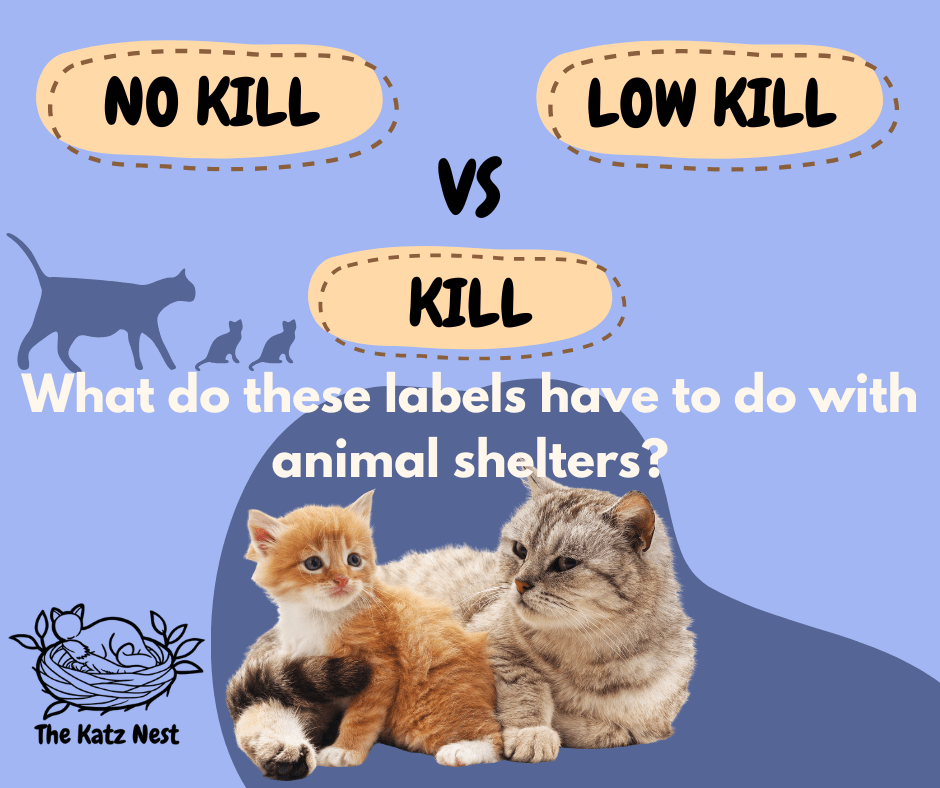
In honor of PetSmart’s National Adoption Week (July 21–27), let’s talk about something many animal lovers are curious about:
What’s the difference between a kill shelter, a no-kill shelter, and a low-kill shelter?
What Do These Labels Really Mean?
Most shelters are categorized by the public into two simplified terms: “kill” or “no-kill.” But the truth is more nuanced, and there’s a third label many don’t know about: low-kill.
To understand these categories, we first need to talk about something called the live release rate.
What Is a Live Release Rate?
A live release rate (LRR) is the percentage of animals that leave a shelter alive—whether through:
- Adoption
- Transfer to rescue partners
- Reuniting with their owner
- Return-to-field (for example, TNR for community cats)
Animals that die in care or are humanely euthanized lower the LRR.
There’s no universally accepted standard, but in general:
- No-kill shelters aim for a 90% or higher LRR
- Some aim even higher (95–97%), depending on their mission or guidelines
Many shelters publish their LRR online, but even when they don’t, they are often required to submit reports to local governments or state departments of agriculture.
What Does “Low-Kill” Mean?
“Low-kill” is not a regulated term. It’s often used by shelters that:
- Fall slightly below the 90% LRR benchmark
- Still make every reasonable effort to place adoptable animals
- Want to be transparent that they occasionally must make difficult decisions
Because it’s not standardized, any shelter can technically call itself low-kill—which is why it’s important to ask questions, look up public reports, or even talk with shelter staff if you’re concerned.
What Is a Kill Shelter?
The term “kill shelter” is controversial and emotionally charged. It usually refers to:
- Shelters that don’t identify as no-kill or low-kill
- Municipal or open-admission shelters, especially in high-population areas
These shelters are often overwhelmed by the sheer number of stray, surrendered, and abandoned animals. With limited space, funding, and adopters, they face heartbreaking choices.
It’s not that these shelters want to euthanize animals. It’s that they often have no other options.
No shelter wants to euthanize animals. Every shelter begins with the same goal: to save lives. But sometimes, shelters become overwhelmed and stressed. It’s important that we as advocates and supporters keep shelters accountable, encouraging them to stay focused on their mission. Sadly, in rare cases, some shelters may lose sight of that goal—whether due to money, fame, pressure, or the pursuit of convenience. While this doesn’t happen often, it does happen. That’s why asking questions and holding organizations to high standards matters. At the same time, remember: shelter workers are human beings who love animals, often forced to make impossible decisions under challenging conditions. The goal is always to do what’s best—not only for the animals, but also for the people who care for them.
The Realities Behind All the Labels
Even no-kill shelters can’t save every animal.
Some arrive:
- Too sick to recover
- Severely injured
- Orphaned as kittens with little chance of survival (neonatal kittens have only a 60–80% survival rate even in the best conditions)
Shelters also must make hard decisions about aggressive animals, especially dogs with bite histories. These animals may go months—or years—without adoption, sometimes spending their entire lives in the system.
This leads to a painful question:
Is it more ethical to keep one animal indefinitely in the hope they’ll find a home—or to humanely euthanize and save five others in their place?
There’s no easy answer—and there likely never will be. Every shelter grapples with this differently.
Why This Conversation Matters
Understanding these labels helps us:
- Support shelters more effectively
- Advocate for animals with compassion and realism
- Make informed choices about adoption, donations, and volunteering
If you’ve ever wondered how shelters make these decisions or what’s really behind the numbers—this is it. During National Adoption Week and beyond, let’s focus not on judgment, but on supporting the people and animals behind the scenes.
Because every life matters, and every choice counts.

 The Katz Nest
Leave a response here!